14 Facts About Pompeii That Will Surprise You
The short answer. The eruption date is disputed by the archaeological park itself. A third of the city is still buried deliberately. The casts are plaster, not bodies. The amphitheatre is the oldest in the Roman world and the Senate once closed it for ten years after a riot. And the Forum was a building site on the day it was buried.
Everything below is sourced to the Archaeological Park's own publications, and every one of them either contradicts what you probably expect or is simply not in the popular account. If you would rather hear them on site, the italy pompeii tours listed here are led by archaeologists.
1. Nobody is sure what day it happened
Pliny the Younger's letters give 24 August AD 79, and that is the date in every textbook. In 2018 the park announced a charcoal inscription found in Regio V dated to the sixteenth day before the Calends of November — 17 October. Charcoal is fragile and unlikely to survive long on a wall, which argues the writing was recent. The park treats the question as open. Autumn also fits the braziers, the heavier clothing on some casts and the fruit in the storerooms.
2. The city was a building site when it was buried
An earthquake in AD 62 damaged the whole Vesuvian area and repairs were still unfinished seventeen years later. Half-repaired walls and stacked materials are not decay; they are the state of the city on the day. Once you know it, Pompeii stops looking like a ruin and starts looking like a town in the middle of a job.
3. A third of it has never been dug, on purpose
Of 66 hectares, about 49 are excavated. What you can walk is therefore two-thirds of it. The rest is left buried because exposing a building starts a conservation obligation that never ends, and the current priority is stabilising what is already open. Pompeii is the rare archaeological site whose main problem is having been dug too fast, not too slowly.
4. The casts are plaster, and that is more remarkable, not less
Bodies buried in ash decayed and left cavities. Giuseppe Fiorelli had liquid plaster poured into them, and what came out preserved the shape of a person at the moment the surge reached them, skeletal remains still inside. What you are looking at is a void, filled. The technique is his, from the 1860s, and it is why Pompeii has images of its dead when Herculaneum has skeletons.
5. The amphitheatre is the oldest in the Roman world
Built in 70 BC by the magistrates Caius Quinctius Valgus and Marcus Porcius, a decade before the Colosseum's site was even a lake in Nero's garden, and holding about 20,000 people — more than the city's likely population.
6. The Roman Senate banned games there for ten years
In AD 59 a riot broke out in the arena between Pompeians and spectators from neighbouring Nuceria. Rome closed the amphitheatre for a decade. The ban was lifted early, in 62, after the earthquake — a small act of consolation to a wrecked town.
7. The Temple of Jupiter is aligned on Vesuvius
The Forum was regularised so that the temple's facade closes the north end of the square. Directly behind it stands the volcano, which is why your photograph of one contains the other. The alignment is deliberate, and it predates any idea that the mountain was dangerous; nobody in Pompeii appears to have known it was one.
8. The walls were already obsolete
Over 3,200 metres of circuit with twelve towers and seven gates, in place by the sixth century BC. By the first century BC they had lost their defensive purpose entirely, and private houses were built into and over them — which is how the Suburban Baths came to sit inside the wall below the Marina Gate.
9. There is a vineyard inside the city
The block by the amphitheatre was read by nineteenth-century excavators as a cattle market, on the strength of the bones. Later work found a large vineyard trained on the vitis compluviata system, a wine press and ten sunken jars with an estimated capacity of 120 hectolitres. A working vineyard is planted there today.
10. The Villa of the Mysteries is not on the standard ticket
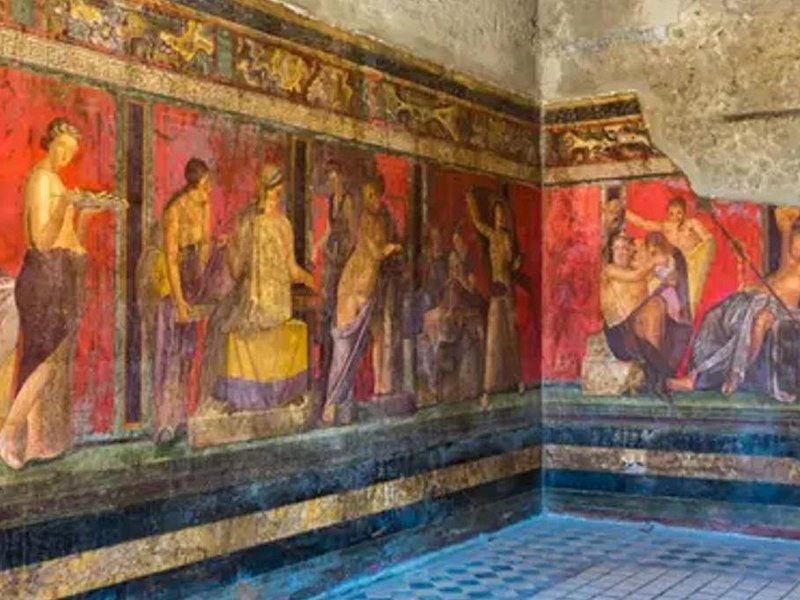
It stands outside the walls, and the €20 Pompeii Express ticket explicitly excludes the suburban villas. Its Dionysiac frieze is among the best-preserved paintings to survive from the ancient world, and the number of people who reach the gate on the wrong ticket is the reason this site has a whole guide about which one to buy.
11. A cellar held 118 pieces of silver
In the House of the Menander, under the small bath suite, a box was found containing 118 silver vessels — mostly plates and cups for banqueting, with shapes for serving wine — hidden before restoration work began. The house belonged to Quintus Poppaeus Sabinus, of the family of Nero's second wife.
12. Your ticket has your name on it
Pompeii introduced a 20,000-a-day cap and personal, non-transferable tickets together. Staff can ask for ID at the gate, and a mismatch means no entry and no refund. Very few published guides mention it, because it is newer than they are. The detail is on the visiting page.
13. Entry is free twelve days a year
Every first Sunday of the month, under Italy's national Domenica al Museo scheme. The catch is that you cannot reserve a free ticket, so on a capped site your entry is not guaranteed and the queue starts before the gate opens.
14. It is bigger than a day
Sixty-six hectares, nine districts, a two-hour tour reaching about a tenth of the streets, and the park's own longest suggested route running seven hours. Travellers all say a version of the same thing: you do not finish Pompeii. How much you can realistically cover is set out on the site map and in the guide to how long you need.
The fourteen, in one table
| # | The fact | The figure |
|---|---|---|
| 1 | Two candidate eruption dates, both from the park | 24 Aug / 17 Oct AD 79 |
| 2 | Years between the earthquake and the eruption | 17 |
| 3 | Hectares excavated, of the total | 49 of 66 |
| 4 | Decade the casting technique was devised | 1860s |
| 5 | Year the amphitheatre was built | 70 BC |
| 6 | Length of the Senate's ban on games | 10 years, from AD 59 |
| 7 | What the Temple of Jupiter's facade faces | Mount Vesuvius |
| 8 | Length of the city walls, and their towers | 3,200 m, 12 towers |
| 9 | Capacity of the vineyard's sunken jars | about 120 hectolitres |
| 10 | Ticket needed for the Villa of the Mysteries | €25, not €20 |
| 11 | Silver vessels found in one cellar | 118 |
| 12 | Daily visitor cap | 20,000 |
| 13 | Free-entry days a year | 12 |
| 14 | Longest route the park itself suggests | 7 hours |
Three things that are not true
- Nobody was frozen where they stood. The casts show people who died in a pyroclastic surge and then decayed over centuries, leaving cavities. What you see is the shape of a void, filled in the 1860s.
- Pompeii was not a small town. Estimates put the population somewhere around 11,000 to 15,000, in a walled area of 66 hectares with an amphitheatre seating 20,000 — because it drew from the whole district.
- The frescoes are not all reproductions. Some famous pieces, including the Alexander Mosaic in the House of the Faun, are copies with the originals in Naples. Most of what you walk past, including the Villa of the Mysteries frieze, is the real thing in place.
Most of these are things a guide says in passing and no sign on the site says at all.
Every guided option, with what each fare covers, is compared on Pompeii Italy Tours.
Tours led by archaeologists
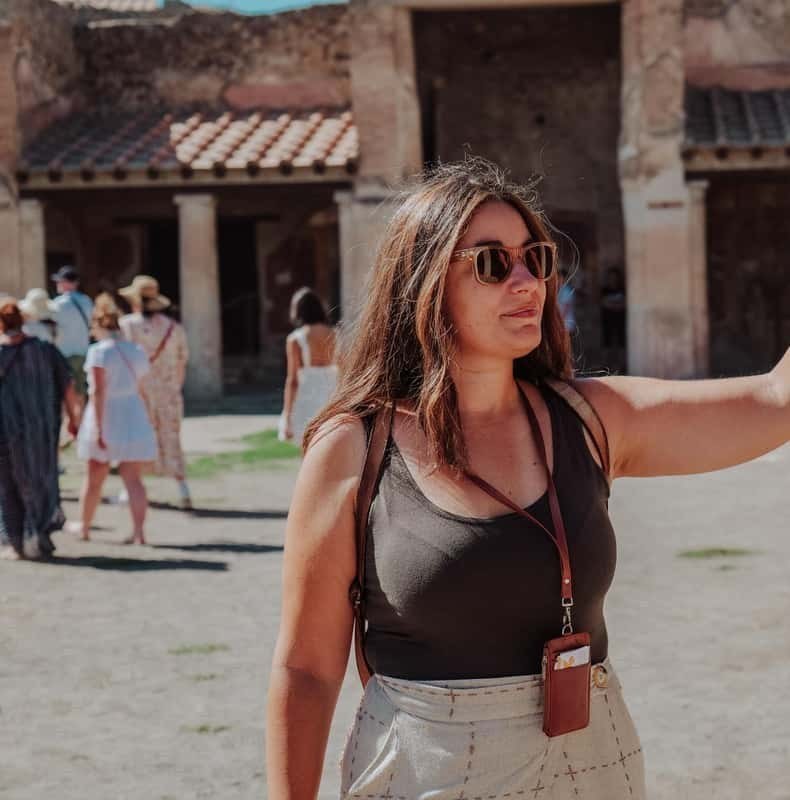
Pompeii 3hours Villa of Mysteries tour with an Archaeologist
Three hours on the villas ticket, ending at the Dionysiac frieze itself.
From $87 per person
Check Availability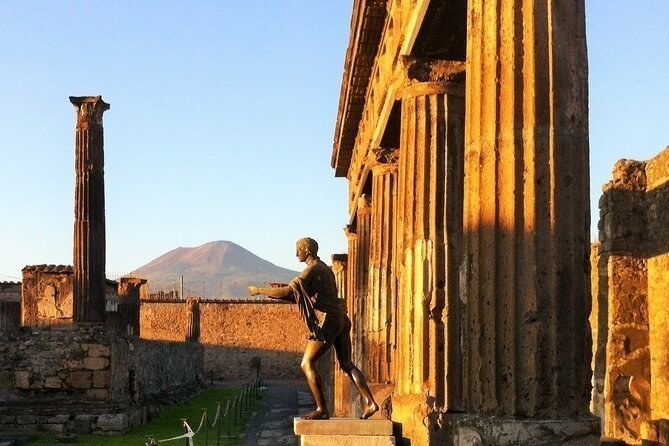
Pompeii private tour with an Official Guide
Guiding only, one to three hours, and the one listing described as step-free.
From $105 per person
Check Availability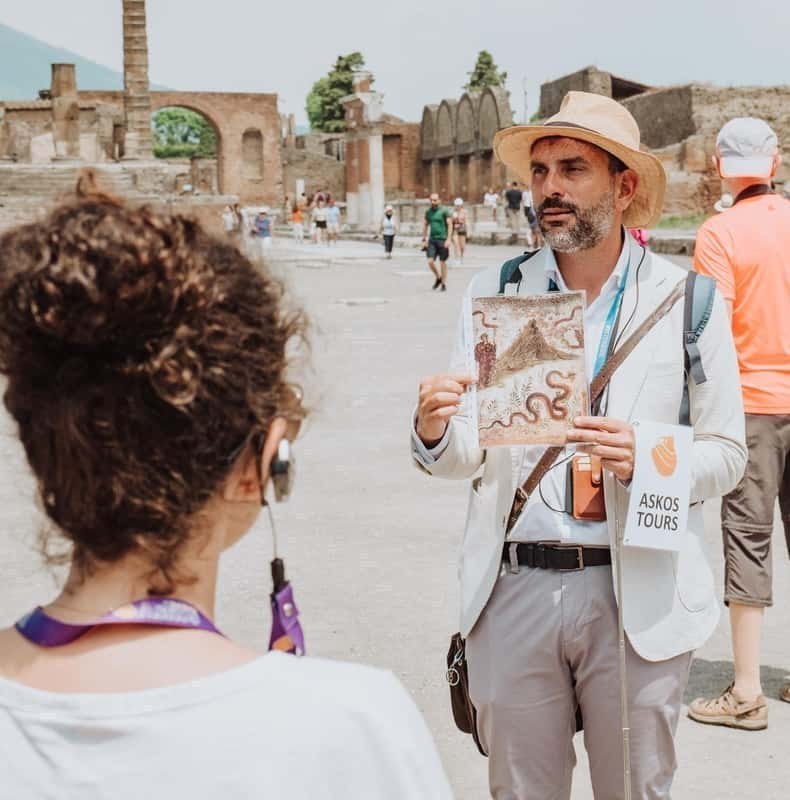
Pompeii: Entry Ticket and Guided Tour with an Archaeologist
The most-booked format here: two hours, a ticket and a licensed archaeologist.
From $57 per person
Check Availability