Inside Pompeii: Every House, Bath and Theatre Worth Your Time
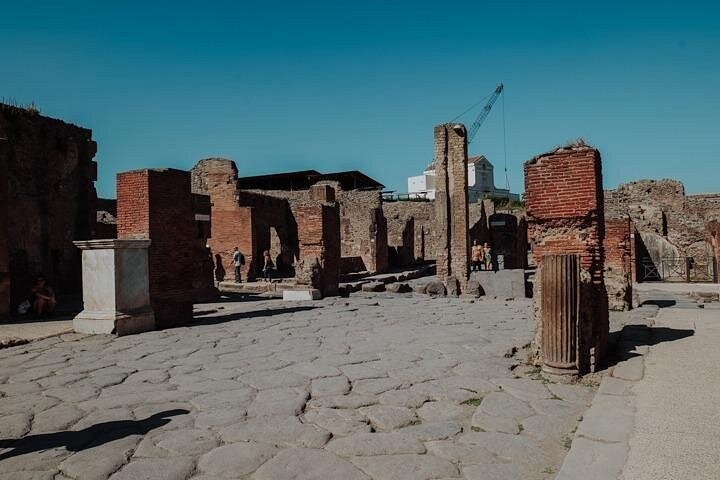
The short answer. Walk it west to east. Start at Porta Marina, take the Forum and the Temple of Jupiter, cut north to the House of the Faun and the House of the Vettii, come back down Via dell'Abbondanza through the Stabian Baths and the Lupanar, and finish at the theatres. That is two to three hours. The Amphitheatre and the Villa of the Mysteries each need a decision of their own.
Pompeii is sixty-six hectares and your guided walk will reach perhaps a tenth of the streets. Knowing which tenth, and in what order, is the difference between a good morning and an exhausting one. This is the order you will actually walk them in, not the alphabet. The walking tours pompeii italy listed here follow roughly the same line.
First: how the site is addressed
Every building at Pompeii has an address made of a regio and an insula — a district and a block — a system Giuseppe Fiorelli imposed in 1858 and nobody has replaced. There are nine regiones. You will see the numbering painted at the street corners, and it is the only navigation the site has, so give it ten seconds of your attention. More on the layout is on the site map.
The Forum, and the mountain behind it
Straight ahead from Porta Marina, and the first thing you reach. The Forum was the whole civic apparatus in one paved rectangle: administration, justice, business, markets and the main public cults. It began as open clay, was given porticoes and a tuff floor between the third and second centuries BC, and was re-paved in travertine under the empire.
Stand at the south end and look north. The Temple of Jupiter closes the square, and its facade is aligned on Mount Vesuvius. Whoever set that alignment did not intend a warning; it has become one, and it is the photograph you will take.
The Basilica
Off the Forum's south-west corner, through five doorways divided by tuff pillars. Fifteen hundred square metres, three naves, two rows of brick columns with Ionic capitals, and a raised platform at the west end where the judges sat. It dates to 130–120 BC, which makes it one of the oldest buildings of its type in the Roman world — and the plan that Christian churches later took over wholesale.
The Macellum and the Forum Baths
On the Forum's east side, the Macellum was the food market: a colonnaded court with shops on the south side, a hall for the imperial cult opposite the entrance, and a circular tholos in the middle where fish were sold and cleaned. Its portico walls once carried painted scenes of the trade going on inside.
The Forum Baths sit just north-west and are the smaller of the two public bath complexes. If you are choosing between the two, take the Stabian Baths later — they are older and better preserved.
North to the House of the Faun
Five minutes up Via del Foro into Regio VI, and the grandest private house in the city: three thousand square metres, an entire block, laid out in the second century BC. HAVE is set into the pavement outside. Inside are two atria and two peristyles, a copy of the dancing faun in the impluvium, and a copy of the Alexander Mosaic in the exedra. Both originals are in Naples, which is worth knowing before you build a day around them.
The House of the Vettii and the House of the Tragic Poet
The Vettii is the most completely decorated house on the site and the one guides use to explain what a Pompeian interior actually looked like. A few streets away, the House of the Tragic Poet carries the CAVE CANEM mosaic — beware of the dog — at its door, now under glass, and the mosaic of actors that gives it its name. Bulwer-Lytton set part of The Last Days of Pompeii here in 1838.
Down Via dell'Abbondanza
The main commercial street, and the one that most rewards walking slowly. You are on basalt slabs polished by cart wheels, between kerbs raised a foot above the roadway, with stepping stones set across a carriageway that doubled as a drain. Shop counters open straight onto it, and you will pass election notices still painted on the walls.
The Stabian Baths and the Lupanar
The Stabian Baths date to the second century BC and are among the oldest known anywhere in the Roman world. Men's and women's suites run the same sequence — changing room, cold, warm, hot — heated by air circulating through wall piping and double floors. The women's door, in the north-west corner of the courtyard, is marked MULIER.
The Lupanar is a hundred metres away and it is the most queued-for room at Pompeii: a small two-storey building with stone beds and explicit wall paintings above them. It is worth your time and it is not worth an hour of it in an August queue. Go early, or walk past.
The theatres
South of Via dell'Abbondanza, the Large Theatre was cut into the hill slope in the middle of the second century BC. An inscription in its eastern entrance corridor names the architect of the Augustan works, Marcus Artorius Primus — one of very few Roman architects whose name survives on his own building. Beside it are the Odeon and the Quadriporticus, which served as the gladiators' barracks.
The two that need a decision
| Building | Where | What it costs you | Worth it if |
|---|---|---|---|
| Amphitheatre | Far east end, by Piazza Anfiteatro | An extra hour of walking each way from the Forum | You have four hours or more, or you enter at that gate |
| Villa of the Mysteries | Outside the walls, past the Herculaneum Gate | The dearer €25 ticket, or an €8 top-up, plus half an hour | You want the best-preserved painted room to survive from antiquity |
The Amphitheatre was built in 70 BC and is the oldest known in the Roman world, holding about 20,000. In AD 59 a riot there between Pompeians and visitors from Nuceria led the Roman Senate to close it for ten years.
The Villa of the Mysteries is the reason the ticket grade matters, and it is covered in full in the ticket guide. Neither Pompeii ticket reaches Herculaneum, which is a separate park twenty minutes up the line with its own admission. Its continuous frieze runs life-size round three walls, showing a rite connected with Dionysus. An Express ticket will not open it.
Five things most people walk straight past
- The cart ruts. Worn into basalt by wheels, deep enough to catch an ankle. They are the clearest physical trace of daily traffic anywhere in the Roman world.
- The stepping stones. Spaced to let a cart axle through and a pedestrian across, which tells you both the width of a Roman cart and the state of the street.
- The election notices. Painted in red on street frontages, endorsing candidates by name. Most visitors read them as decoration.
- The bar counters. Masonry counters with sunken jars, opening onto the street. Pompeii had dozens of them.
- The half-finished repairs. The city was still rebuilding after the earthquake of AD 62 — the scaffolding state is original, not decay. The story is on the history page.
If you only have ninety minutes
Forum, Temple of Jupiter, Basilica, House of the Faun, Via dell'Abbondanza, Stabian Baths, out. That is the spine, and it is what a two-hour guided walk delivers with the commentary that makes it legible. What each building actually is, in more detail, sits on the houses and public buildings page; the practical rules are on the visiting page and in the FAQs.
A guide who works on the site knows which houses are open today, which is not a thing any map can tell you in advance.
Every guided option, with what each fare covers, is compared on Pompeii Italy Tours.
Tours that walk this route
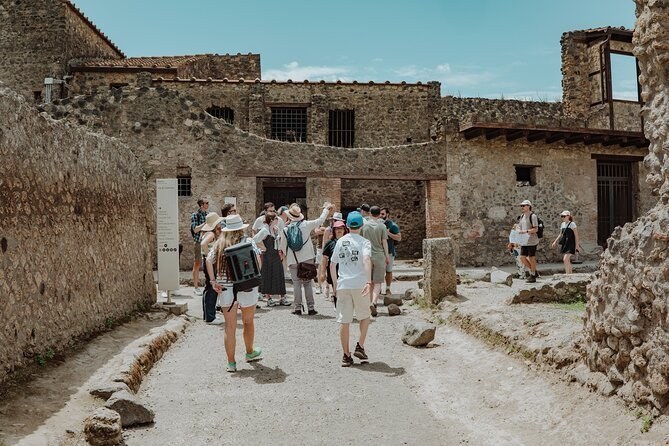
Pompeii & Villa of Mysteries Small Group Tour with Archaeologist
The same villas route, capped at twenty, at the lower of the two fares.
From $59 per person
Check Availability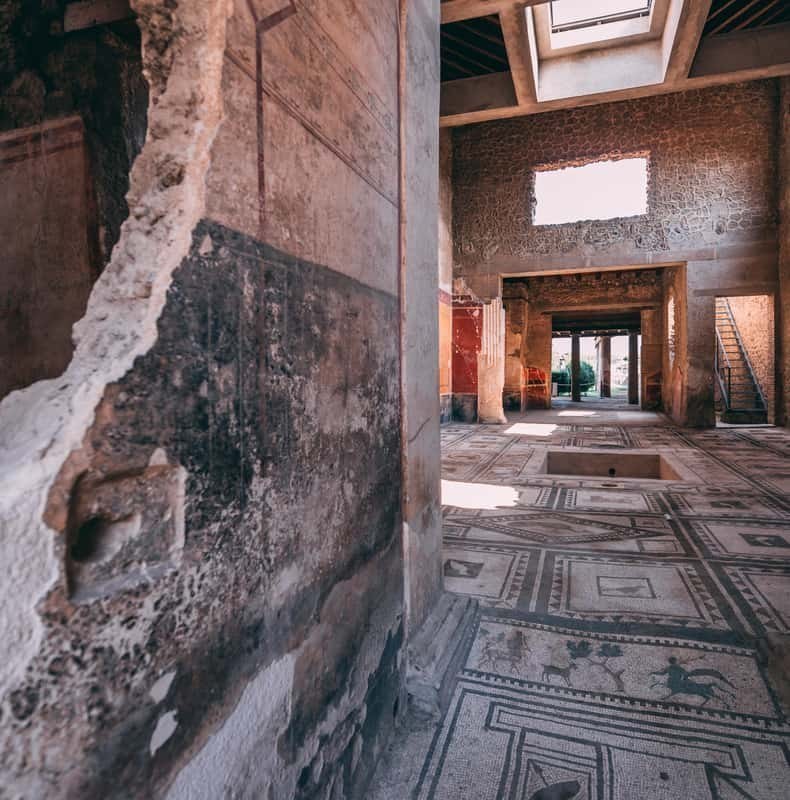
Pompeii: Private Tour with an Archaeologist
Your own archaeologist for three hours, in any of nine languages.
From $523 per group, up to 1
Check Availability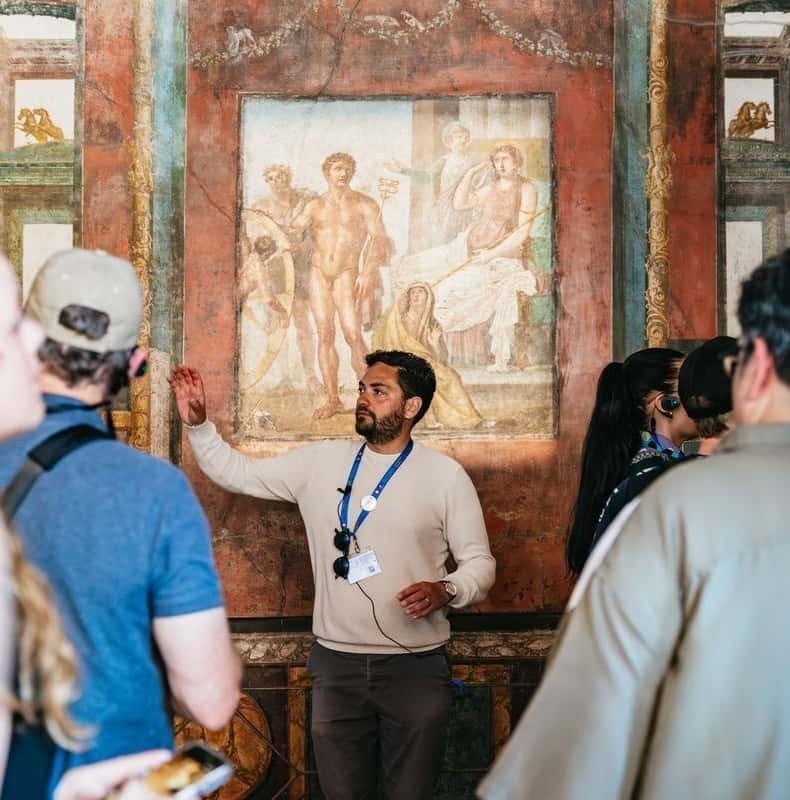
Pompeii: Exclusive Tour with Archaeologist and Entry Tickets
Ten named stops in two hours, with a headset and a small group.
From $64 per person
Check Availability